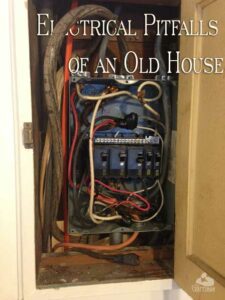
 Image Credit: Scott Sidler
If the picture of this breaker box doesn’t scare the pants off you, then you are one crazy, living on the edge kinda person. It doesn’t take a professional to know that this is not a well designed electrical system.
My wife and I are finally turning our unfinished attic into a kid’s bedroom this year to make room for our growing family (our 2nd boy was just born!). I’ll be doing a few posts on the process soon to give you the inside scoop on the project.
For the attic, we needed to have new lines run to the upstairs, so I called in my favorite electrician to do the work for me. Steele of WALSTIB Electric does most of my electrical work in Orlando because he knows old houses so well. And with a name like Steele, how can you go wrong?
I know old houses well enough to know that I don’t want to take any chances messing with the rat’s nest of wires in this place myself. There’s a time to call a pro and for me, this is the time.
While he was here, I got to thinking, “What a great post it would make to ask him about the biggest dangers he finds when it comes to electrical systems in old houses.”
So, today I’m going to let you pick the brain of a professional electrician who often works in old houses.
Here are his answers to four of my biggest questions about old electrical systems.
Why is knob & tube wiring so dangerous?
Knob & tube wiring was one of the first forms of electricity in houses. For its time, the system was ingenious and simple. It was incredibly safe initially, but has some shortfalls that are exacerbated by old age.
Problem #1: Knob and tube connections were soldered and taped so they were very strong, but they were not done in a junction box. So, if one of these connections should happen to fail, it creates a definite fire hazard since it is exposed.
Problem #2: The insulation used on knob and tube wiring was rubber, which becomes very brittle with age and eventually crumbles off. This missing insulation means that there can be exposed live wires in walls and attics, which is never good.
With many old houses without insulation, this wasn’t as big of a fire hazard as it is today when homeowners unknowingly install blown-in insulation over active knob & tube wiring creating a very big fire risk.
Solution: If you suspect your house has any knob & tube wiring, have a licensed electrician determine if it is still active and replace it as soon as possible.
What is the most common safety issue with electrical systems you come across in old houses?
I’d have to say that would be all the patches and splices that inevitably occur over time. What was initially a well thought out electrical plan becomes a mess of wires from different generations of additions and changes to the electrical needs of the occupants.
I see lots of hidden junction boxes which is a big No No. Also, way too much use of electrical tape to patch things up. Electrical tape is not a permanent solution to an electrical problem, but a lot of homeowners and handymen use it that way.
Another big problem is overloaded circuits. Adding one new outlet to a circuit doesn’t usually cause a problem, but adding four over the course of 40 years will cause an overloaded circuit due to today’s higher electrical demands.
What’s the story on aluminum wiring? Is it really a problem?
Aluminum wiring became a popular alternative in the 1960s and 1970s due to skyrocketing copper prices. The problem with aluminum wiring isn’t actually the wiring- it is an issue of connecting dissimilar metals and the results can cause arcs and fires.
Here’s the typical scenario:
A homeowner or electrician adds new receptacles or switches to the house. Standard receptacles have brass screws which are a copper alloy, so they work fine in most houses, but with aluminum wiring, you need specialized electrical components that have aluminum fittings.
Most folks wouldn’t think about this and so they will install the standard receptacles which will cause galvanic corrosion and eventually lead to an arc and possible fire.
Solution: Investigate whether your house has aluminum wiring and make sure anything that connects to the wiring is made of aluminum, NOT brass or copper.
What can a homeowner best do to protect themselves when buying an old home with old wiring?
The best thing you can do is have a thorough inspection by an electrician you trust. They will be able to point out potential issues, though there is no way to tell exactly what is hiding behind the walls.
They will be able to make suggestions based on their experience to help you have as safe a house as possible.
I hope you learned as much as I did from my interview with Steele. I always think that the biggest fears we have regarding old houses lie in the unknown. The more we know, the less we worry about things.
So, take this opportunity to do a little detective work on your house or get your electrical system checked out by a pro so you know what you’re dealing with.